
Issue 1

Replay
Highlights from a Forge seminar, shared exclusively with subscribers.
In this session, Ben Parry arranges Abba's Dancing Queen in real time with suggestions and questions from Cohort #001.



Voices
Real voices from the student community - sharing their stories, progress, and perspectives.

Leslie Wanyama - Kenya
Cohort #001 member Leslie talks about what brought him to choral music and how he balances his conducting with his medical degree in Hungary!
January cohort member Leslie talks about what brought him to choral music and how he balances his conducting with his medical degree
I didn’t grow up thinking I would become a conductor. In fact, for a long time, music and medicine felt like two completely separate paths—one something I loved, the other something I was expected to pursue. It was only later that I realised they didn’t have to compete.
My first real encounter with choral music came at school. I joined the choir almost by accident—I needed something to break up the intensity of studying, and it seemed like an easy option. It wasn’t. What struck me immediately was the sense of collective responsibility. You couldn’t hide, but you also weren’t alone. The sound only worked if everyone listened as much as they sang. That idea—of shared attention—stayed with me.
Over time, I found myself becoming more curious about how rehearsals worked. Why did some rehearsals feel focused and energised, while others drifted? Why did certain gestures from a conductor change the sound instantly? I didn’t have the language for it then, but I was already starting to think like a conductor.
Medicine, meanwhile, demanded structure, discipline, and long hours. There isn’t really a way around that. One of the biggest challenges has been accepting that I can’t do everything, all the time. There are weeks where the balance tips heavily towards medicine—exams, placements, long days—and music has to take a quieter role. Earlier on, I found that frustrating. Now, I try to see it differently.
What’s helped is treating both areas with the same mindset. In medicine, progress is incremental—you don’t suddenly become competent overnight. The same is true in conducting. A rehearsal doesn’t need to solve everything. It just needs to move something forward. That shift in thinking has made both feel more manageable.
Practically, I’ve had to be quite intentional with my time. I plan rehearsals more carefully than I used to, because I know I won’t have endless hours to prepare. I also try to keep a small number of clear priorities in each rehearsal rather than trying to fix everything. Interestingly, that constraint has actually made my rehearsals better.
There’s also something unexpectedly complementary about the two disciplines. Medicine trains you to observe closely, to listen, to respond to what’s actually in front of you rather than what you expect to see. Conducting requires exactly the same thing. You can’t impose a sound—you have to notice what’s there and work with it.
Being part of the Forge has helped me connect those ideas more consciously. It’s given me a framework for thinking about rehearsal, sound, and communication in a way that feels practical rather than abstract. More importantly, it’s reminded me that improvement doesn’t come from doing more, but from doing things with greater clarity.
I’m still figuring out how the balance will look long-term. But for now, I’m less concerned with perfectly dividing my time, and more focused on staying engaged in both. In a way, that’s what drew me to choral music in the first place: the idea that individual parts, however different, can still work together to create something coherent.

Rachel Staunton - UK
After years rooted in London, Rachel reflects on a transformative trip to India, her commitment to youth choral music, and why she joined Forge.
Earlier this year, I had the extraordinary opportunity to travel to India in my (self-appointed) role as Director of Singing and Good Vibes at an international conference for education leaders from across the globe.
For context, the past few years have been full. Alongside raising a young family, I’ve been running choirs and establishing a large choral charity in London. During that time, I also underwent life-saving treatment and surgery that kept me close to home, tethered to hospital appointments and unable to travel beyond the city.
So, to find myself once again boarding a plane, collaborating with inspiring people from a wide range of disciplines, and experiencing the world through different cultural lenses felt deeply significant. It reminded me - quite powerfully - of two things: how much I love learning, and how much I believe in the transformative power of singing.
I hold two music degrees, one from the University of London and another in choral conducting from the Royal Academy of Music, and I have been directing choirs since I was 21. Twenty years on, it is still children’s and youth choirs that make me tick. I am wholeheartedly committed to the impact singing can have on young people - the confidence it builds, the community it creates, and the joy it unlocks.
This passion drives my work in London, where I am on a mission to make choral singing accessible, inclusive, and exceptional for a wide range of young people. I am particularly motivated by the challenge of engaging those who might not otherwise have the financial means, family support, or opportunity to take part. Broadening who gets to stand on the concert platform - and who gets to stand on the podium - is central to everything I do.
With this in mind, applying for the Forge online conductor training and mentoring programme felt like a natural next step. The calibre of mentors - musicians who are not only exceptional teachers but also generous, thoughtful leaders in the field - was immediately compelling. The programme’s ethos of shared learning, honest reflection, and mutual support speaks directly to the realities of conducting: a role that is as demanding as it is rewarding.
I am excited to begin my Forge course. For a busy mum juggling multiple choirs, concerts, and the inevitable last-minute engagements, the opportunity to learn from home could not come at a better time. There is something wonderfully grounding about putting the washing on, preparing a meal, and then logging in for time that is both restorative and intellectually energising.
Ultimately, this is not just an investment in me, but in the hundreds of young people I work with. The learning, insight, and inspiration I gain will ripple far beyond my own practice - shaping rehearsals, performances, and experiences for years to come. And that, to me, is what makes this journey so meaningful.


10 minutes with...
Joseph Michael Barrett
Forge Mentor Joseph Michael Barrett sits down with Forge co-founder Tori Longdon to talk about growing up in South Africa, eating horse and creating one of the finest youth choirs in the world.

Resources
Direct from the Forge mentor team - exclusive content to support your singing and rehearsals.
Dancing Queen
Crafted by Ben Parry during a Forge seminar earlier this month, this exclusive SATB arrangement of Dancing Queen is now available for free download.

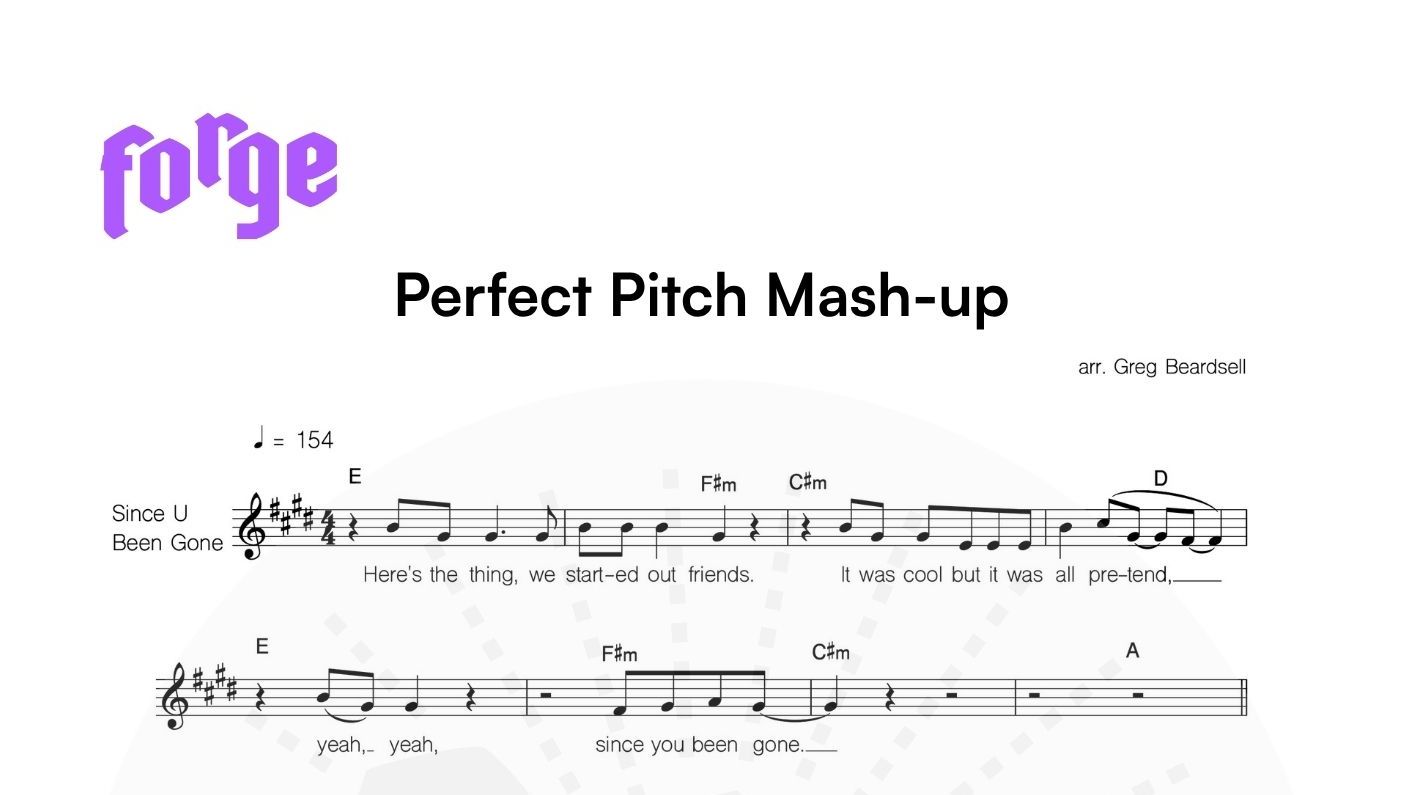
Monthly Mash - Pitch Perfect
Greg Beardsell blends, bends, and rebuilds repertoire - one fresh creation, every month. Use as a warm-up song and make as complicated as you like.
The Forge Favourite
Each week, one of our team demonstrate their all-time, failure-free, education-rich warm-up song. Greg Beardsell demonstrates "Mrs O'Leary"...

Ask Forge
Real questions from Forge readers answered by the mentor team.
“When a longstanding singer’s voice declines, what should I do?”
Answered by Mariana Rosas
Question
I direct an auditioned adult choir, and one long-standing member’s voice is now deteriorating, affecting sound, tuning, stamina, everything! We don’t have a re-audition policy, and I feel a strong sense of loyalty, but it’s impacting the overall sound and it's beginning to really frustrate other members. How can I handle this sensitively and fairly?
Choir Type
Chamber / auditioned choir
Age Group
Adults
Size
20–40
Entry / Recruitment
Formal audition
Rehearsal Pattern
Once a week
90–120 mins
Experience Level
Advanced
Repertoire / Style
Mainly classical repertoire - Renaissance to contemporary, often performed a cappella.
Optional Context
The singer has been with the choir for over 15 years and is well-liked. I’m concerned about handling this without causing embarrassment or damaging group morale
A few thoughts on one of the hardest things a conductor must do -
#1 Being concerned about this issue means you are a caring and empathetic leader who understands that interpersonal relations and people’s feelings are at the core of what we do, and that in itself is positive.
However,
#2 In an auditioned chamber choir, your members expect certain musical standards, and it is your duty to do everything in your power to achieve that.
Importance of having concrete and transparent procedures -
#3 The situation described is about a specific member, but it’s important to take this opportunity to create a process that will help you navigate this situation and similar future ones. The process should not be linked to a particular member, but to principles that you consider right and fair.
Regular re-auditions / Vocal strategy -
#4 There are different formats of re-auditions you could explore and find the one that suits your group (every 1, 2, 3 years; individual or in small groups; etc) It’s important that the re-auditions are linked to a vocal strategy that can support your members to thrive.
The re-auditions are your opportunity to give people individual feedback, let them know if there are areas that need improvement and what they can do to meet the expectations.
Warn them so they know that something isn’t working, to help them prepare for the possibility of them having to leave the choir.
Let them tell their story: it’s likely that the choir is an important part of members’ lives. Let them have some agency in how to close this chapter by establishing a time frame for them to leave. Keep the feedback confidential, so they can decide the story they will tell.
Having to ask a member of an amateur group to leave because they no longer meet the musical standards is one of the hardest things you’ll do as a conductor, but your members will appreciate that you are looking after the choir and everybody’s hard work.
Some people will understand it, some people might hate you, and sadly, that is something we cannot control. The clearer the process, the easier for you to navigate it in an impartial and fair way.
Mariana Rosas
Chorus Director, London Symphony Chorus
“Why do my confident singers look unconfident when performing?”
Answered by Tori Longdon
“How do I improve choir attendance without putting people off?”
Answered by Tracy Wong
Got a question?
Send us your question - selected ones will be passed to our mentor team and may be featured in an issue of the Edge.
Click here